Exploring the Mysteries of Quantum Entanglement
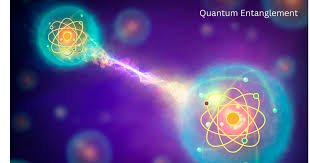
Exploring the Mysteries of Quantum Entanglement
Quantum entanglement is one of the most fascinating and perplexing phenomena in the world of quantum mechanics. Described by Albert Einstein as “spooky action at a distance,” quantum entanglement refers to a situation where two or more particles become intertwined in such a way that the state of one particle is directly related to the state of another, no matter how far apart they are. This concept challenges our conventional understanding of space and time, and it continues to captivate physicists and researchers alike.
In essence, quantum entanglement occurs when two particles, such as electrons or photons, interact in a way that their quantum states become linked. Once entangled, any change to one particle will instantaneously affect the other, even if the particles are separated by vast distances. This instantaneous connection appears to defy the classical limitations of speed, as nothing can travel faster than the speed of light according to Einstein’s theory of relativity. Despite this, quantum entanglement has been demonstrated in numerous experiments, making it a central topic in modern physics.
To understand entanglement, it’s crucial to first grasp the fundamental principles of quantum mechanics. In the quantum realm, particles behave in ways that are fundamentally different from what we observe in our everyday lives. A particle can exist in a superposition, where it can be in multiple states at once—until it is measured. When particles are entangled, their quantum states become linked, creating correlations between them. For example, if two entangled particles are created in a superposition of two states (say, spin-up and spin-down), measuring the spin of one particle will immediately determine the spin of the other, regardless of the distance between them.
This phenomenon was first proposed by Einstein, Podolsky, and Rosen in 1935 in what is now known as the EPR paradox. They argued that if quantum mechanics were correct, then entangled particles would allow for “instantaneous” communication between them, which seemed to violate the principle of locality (the idea that objects are only influenced by their immediate surroundings). Einstein, a staunch critic of quantum mechanics, dismissed this as a flaw in the theory, but experiments conducted in the following decades would demonstrate that quantum mechanics was indeed correct.
One of the most significant experiments demonstrating quantum entanglement was conducted by physicist John Bell in the 1960s, known as Bell’s Theorem. Bell formulated a mathematical inequality that, if violated, would confirm the existence of entanglement. Subsequent experiments, most notably those by Alain Aspect in the 1980s, showed that entangled particles do indeed violate Bell’s inequality, providing experimental evidence that quantum entanglement is a real phenomenon.
The implications of quantum entanglement are far-reaching and extend beyond fundamental physics. One of the most promising applications is in the field of quantum computing. Quantum computers leverage the principles of superposition and entanglement to perform calculations that would be impossible or take an impractical amount of time for classical computers. Quantum entanglement enables the superposition of states that exponentially increase computational power, offering the potential to revolutionize industries ranging from cryptography to medicine.
Entanglement also plays a key role in the emerging field of quantum teleportation, where the quantum state of a particle is transferred from one location to another without the physical particle itself moving. This could lead to advances in secure communication systems and even, potentially, in the transportation of information over long distances without the need for traditional data transfer methods.