The Fascinating World of Black Holes and Gravitational Waves
The Fascinating World of Black Holes and Gravitational Waves
Black holes and gravitational waves are two of the most awe-inspiring and enigmatic phenomena in the universe. Together, they provide a window into the deepest mysteries of space and time, offering insights into the nature of gravity, the behavior of matter under extreme conditions, and the fundamental structure of the universe. Though black holes have been theorized for over a century, it is only in recent decades that we have gained a deeper understanding of these cosmic objects and the ripples they create in spacetime—gravitational waves.
A black hole is an astronomical object with such strong gravitational pull that nothing, not even light, can escape from it. This extreme force is a consequence of the warping of spacetime, as predicted by Albert Einstein’s theory of General Relativity. Black holes form when a massive star exhausts its nuclear fuel and collapses under its own gravity, condensing all its mass into an infinitely small point known as a singularity, surrounded by an event horizon. The event horizon is the boundary beyond which nothing can escape; once an object crosses it, it is lost to the black hole.
Black holes come in various sizes. Stellar black holes, which are formed from collapsing stars, typically have a mass between 3 and 10 times that of our Sun. Supermassive black holes, with masses millions or even billions of times that of the Sun, reside at the centers of most large galaxies, including our own Milky Way. These supermassive black holes exert immense gravitational influence on their surroundings, affecting the motion of stars, gas, and even the formation of galaxies.
The study of black holes has captivated scientists and astronomers because of their extreme nature and their role in testing the limits of our understanding of physics. The behavior of matter near a black hole, particularly the effects of gravitational forces on time and space, challenges our conventional notions of reality. For instance, time slows down as an object approaches the event horizon, a phenomenon known as time dilation. This is a direct consequence of the way gravity warps spacetime, as described by Einstein's theory of General Relativity.
While black holes themselves cannot be directly observed, their presence can be inferred through the effects they have on nearby objects. One of the most compelling methods for detecting black holes is by observing their gravitational influence on companion stars or surrounding matter. In some cases, gas and dust are pulled toward a black hole, forming a hot, glowing accretion disk as the material is accelerated and heated to extreme temperatures before being swallowed by the black hole. These disks can emit X-rays and other forms of radiation, which astronomers can detect with telescopes, revealing the presence of a black hole.
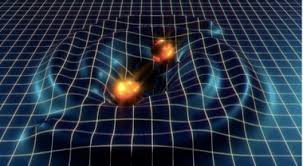
In addition to black holes, another revolutionary discovery in modern astrophysics has been the detection of gravitational waves. Gravitational waves are ripples in the fabric of spacetime caused by the acceleration of massive objects, such as when two black holes or neutron stars orbit each other and merge. These waves travel at the speed of light and carry information about the violent events that caused them, offering a new way to observe the universe.
The first detection of gravitational waves came in 2015, a groundbreaking moment in the history of physics. The Laser Interferometer Gravitational-Wave Observatory (LIGO) detected waves produced by the merger of two black holes more than a billion light-years away. This discovery confirmed a key prediction of Einstein’s General Theory of Relativity and opened up an entirely new field of astronomy—gravitational wave astronomy. Since then, LIGO and the Virgo detector in Europe have observed numerous black hole mergers, providing unprecedented insights into the properties and behavior of these mysterious objects.
Gravitational waves are important because they offer a way to study the universe that is different from traditional methods, such as observing light or radio waves. While light can be absorbed or blocked by interstellar dust and other obstacles, gravitational waves can travel through space with minimal interference, allowing scientists to observe events that would otherwise be hidden. For example, the detection of gravitational waves from merging black holes has given us a new understanding of the frequency and distribution of these events in the cosmos.
The study of black holes and gravitational waves is also pushing the boundaries of fundamental physics. The extreme conditions near black holes provide a natural laboratory for testing theories of gravity, quantum mechanics, and the nature of spacetime. For instance, scientists are exploring the possibility that black holes may provide a link between quantum mechanics and gravity, two areas of physics that have traditionally been studied separately. Understanding how these two fundamental forces interact could lead to a unified theory of physics, one of the most elusive goals of modern science.
In conclusion, the study of black holes and gravitational waves has revolutionized our understanding of the universe. Black holes remain one of the most fascinating and mysterious objects in astrophysics, with their ability to warp spacetime and challenge our understanding of physics. Meanwhile, gravitational waves have opened up a new way to observe the universe, allowing scientists to detect and study events that were previously undetectable. As technology advances and our ability to detect and study these phenomena improves, the next few decades promise to bring even more discoveries, deepening our knowledge of the cosmos and the fundamental nature of reality itself.